
Early engagement helps long term retention
For many businesses, retention is something that gets talked about after the hard work of acquisition is done.
Your campaign has gone live.
You’ve got a pipeline of shiny new leads.
You’ve even managed to convert some of them immediately: what a win.
But very often, attention then moves on to the next campaign: how can we make it bigger and better?
Yet retention is a more cost effective way of growing your customer base than focusing purely on acquisition. In fact, your retention strategy needs to be firmly in place before you’ve even acquired a customer, because early customer engagement is an indicator of long term retention and increased lifetime value.
Your customer base is a leaky bucket
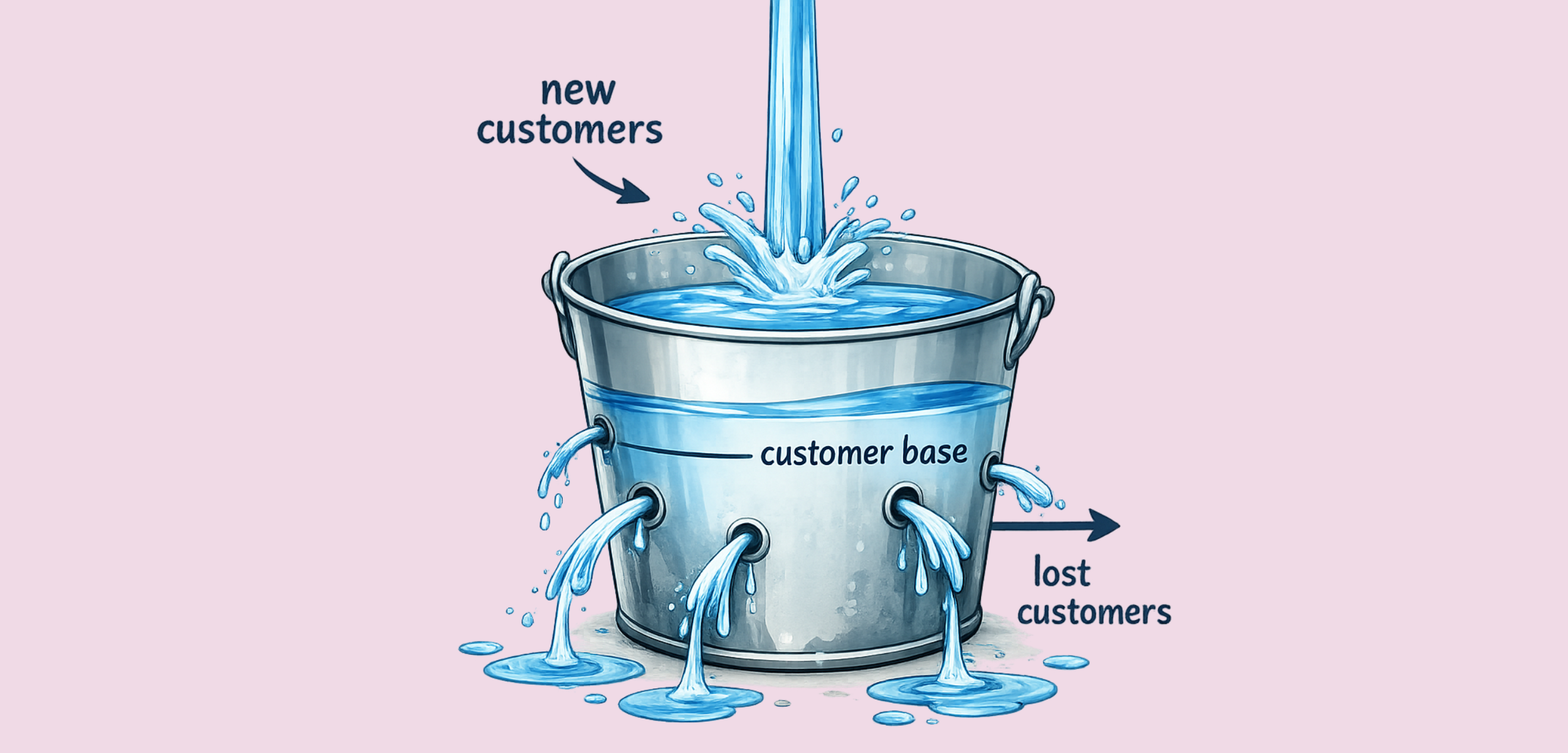
You may have heard of the leaky bucket analogy: imagine your customer base as a bucket. The problem is, it’s a leaky bucket. Lots of holes in it. You fill the bucket with water (new customer acquisition), but because there are holes in the bucket, the water is constantly leaking out (churn). In order to keep the water level even, you either need to keep pouring in more water, or concentrate on filling those holes to reduce churn. An effective engagement strategy is a way of plugging those holes.
How can you keep your customers engaged?
Acquiring new customers is just the first step. Keeping them engaged with your product or service gives you a better chance of retaining them, thereby increasing their lifetime value.
One of the easiest ways to engage a customer immediately is by ensuring you acknowledge their existence. It sounds simple, but I’m often surprised at how few companies have a basic welcome email in place. At this stage, it doesn’t even need to be a full onboarding journey - but at a minimum, there needs to be a communication that thanks them for signing up. If you can deliver immediate value to them, even better.
Your acknowledgement, or welcome email, helps you set expectations. Who you are, what they can expect from you, how often. You’ll often see that welcome emails have some of the highest open and click through rates (CTRs). It’s an opportunity to engage with them while you’re still top of their mind.
Retention is shaped from the very first interaction someone has with your brand.
Developing that first email into a multi-step onboarding journey will deepen the engagement and help convince your customer that you’re a brand they want to spend their time and money with.
It’s worth noting that an engagement-first approach recognises that long-term value is built through consistent, relevant experiences, not isolated campaigns. You still have that leaky bucket, but by regularly delivering value to your customer, you’re ensuring that you don’t have so many holes.
How do you know if it’s working?
Once you’ve spent some time looking at your retention strategy and implemented elements that you’re convinced will help keep customers coming to you, time and again, you need to prove that it’s working.
What are the KPIs and proof points you can look at?
Early immediate indicators are email open rates and click-through rates. Depending on your type of business, you could expect to see higher repeat traffic to your site, increased time spent on site, or an action taken (such as booking an appointment or filling out a questionnaire).
If you’re an e-commerce brand, you could look to reduce the time taken from sign up to first purchase. Over a longer time period, look out for repeat purchases and increased average order value (AOV).
If you’re a subscription business, look at whether your first time renewal rate has increased since your engagement strategy has been in place.
Higher customer engagement delivers longer term value, too. The more engaged a customer is, the more likely they are to become an advocate for you – recommending you to their friends and family, or giving you a 5-star review.
Not only that – an engaged customer is also more likely to accept a price increase. If they’re using your product or service regularly and are happy with it, I can guarantee they’re far more likely to stay with you if your prices increase compared to a customer that rarely engages, has forgotten that you exist, and decides their money is better spent elsewhere.
Engagement marketing works best when it’s embedded, not bolted on.
When engagement is built into the strategy from day one, retention becomes a natural outcome rather than a constant battle.
If you’ve realised that your customer strategy needs a sharper focus on engagement, let’s chat. I’ve got years of experience in shaping and delivering engaging marketing strategies that have increased retention rate, customer lifetime value and overall profitability.
